Those early months as a newcomer to Canada were not easy. Terina will tell you.
Just 28 years old, with five children under age seven (including a newborn), she and her husband arrived in Canada—a country with a climate and a language she didn’t initially understand.
But then, Terina will also tell you—in strong, confident English—how much has changed since that day in 2021.
“Now, I’m proud to say that I am Canadian!” she says with a smile, the ink barely dry on her 21-day-old Certificate of Citizenship.
“I passed,” she says, “because WoodGreen helped me improve my English and prepare for my citizenship test.” Without that vital support, Terina says she wouldn’t be a Canadian citizen today.
Overcoming Loneliness in Canada’s Biggest City
Despite living in Canada’s largest urban centre, surrounded by seven million people, this newcomer to Toronto initially felt isolated and alone. As her husband and oldest children ventured out into their new country, Terina was at home managing with young children. Back in Afghanistan, she had been an elementary school teacher.
She deeply wanted to learn English and build a community, but soon discovered that dragging young children through winter snow and navigating multiple public transit transfers to the nearest language school presented massive hurdles. Even if she could get herself there, childcare was financially out of reach—an impossible expense when you don’t yet speak enough English to secure a job to pay for it.
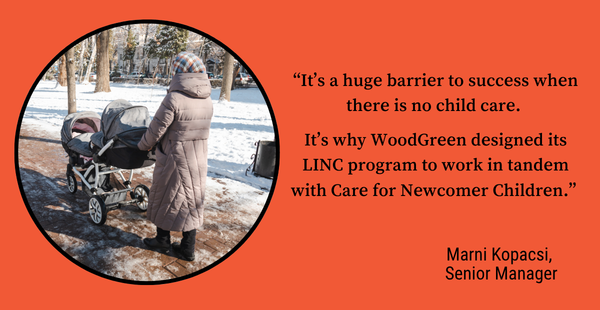
“It’s a huge barrier to success for any newcomer when there is no child care available,” says Marni Kopacsi, Senior Manager of Newcomer Language Services. It’s exactly why WoodGreen designed its Language Instruction for Newcomers to Canada (LINC) program to work in tandem with the Care for Newcomer Children initiative.
Classes Tailored for Newcomer Child Care
Newcomers taking WoodGreen language classes receive free, on-site childcare for their non-school-age children (ages 19 months to 4 years). Kopacsi notes that experienced Early Childhood Educators are deeply sensitive to the unique needs of newcomers and their families, many of whom are navigating English for the first time. The vibrant, multicultural mix in the children’s playroom beautifully mirrors that of the adult classroom.
That rich diversity is one of the main reasons Terina loves Canada and her time at WoodGreen. After first trying online language classes, moving into the city meant she could go to in-person classes for 2.5 hours a day, four times a week.
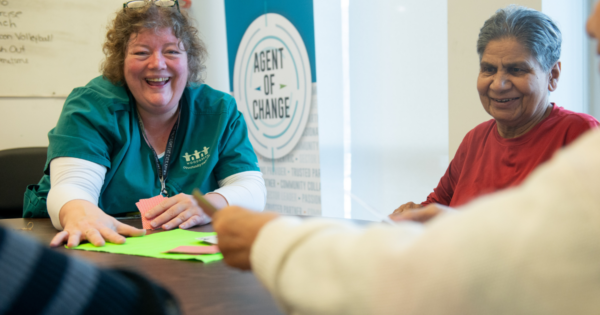
“I love it because people from all around the world come to WoodGreen; different countries, different cultures. We learn about their culture, their food, everything,” she says. “I’ve made so many friends from all over. We call each other all the time.”
Practical Language Skills for Toronto Newcomers
Building social, community connections and overcoming systemic isolation is just as important as building core language skills, says Kopacsi, who emphasizes that WoodGreen allows clients’ everyday practical needs to drive the curriculum.
“We are a little different from standard English-as-a-second-Language (ESL) programs,” she explains.
“We’re not teaching you how to read a novel. We’re teaching you how to read your child’s report card or a prescription label, and then helping you practice the exact questions you can take directly into a Toronto school or pharmacy.”
Speaking is given just as much weight as reading, writing, and listening, which is why WoodGreen’s LINC framework targets all four communication areas. Clients’ skill levels span from absolute beginner to Canadian Language Benchmark (CLB) 4—the exact level of fluency required to obtain Canadian Citizenship.
Kopacsi notes that due to structural factors, conflict, or cost, some newcomers have had interrupted formal education or may have minimal literacy skills in their native language. WoodGreen has the specialized experience and skilled staff to support newcomers to Toronto, no matter where—or when—they need it. LINC classes are offered flexibly in-person or online across weekday mornings, afternoons, evenings, and Saturdays.
“Many newcomers are working where they can, when they can, and that’s often in the gig economy with irregular shifts,” says Kopacsi, adding that adaptive class times ensure everyone has an equitable chance to learn.
Constructing a Bright Future in Canada
Terina says without WoodGreen’s holistic, wraparound approach, she might still feel isolated and lonely.
“It gave me the time and space to learn English. My kids were safe, happy, and right nearby. It was incredibly helpful. I just love the team there,” she says. “I would wholeheartedly recommend this program to every newcomer in Canada”
What’s next for Terina?
The entire family—mom, dad, and all five children—are now officially Canadian citizens. Her children proudly wore matching red and white Canada shirts as they took their oaths together. But Terina isn’t quite ready to say goodbye to WoodGreen just yet.
She has recently applied to channel both her growing English fluency and her past teaching experience into WoodGreen’s Diploma in Early Childhood Education for Newcomers, offered in partnership with George Brown Polytechnic.